BC & AD Date Calculator
Measure the interval between BCE and CE dates using an explicit Gregorian or Julian calendar. Compare calendar days, weeks, years, and months across eras.
Interactive workspace
The workspace uses JavaScript. Read the instructions, method, and worked results while it becomes available.
Read the worked examplesHow to use BC & AD Date Calculator
- Enter each date using a positive year and select BCE or CE.
- Choose the proleptic Gregorian or Julian calendar for both dates.
- Calculate the signed day difference and calendar-unit breakdown.
What is BC & AD Date Calculator?
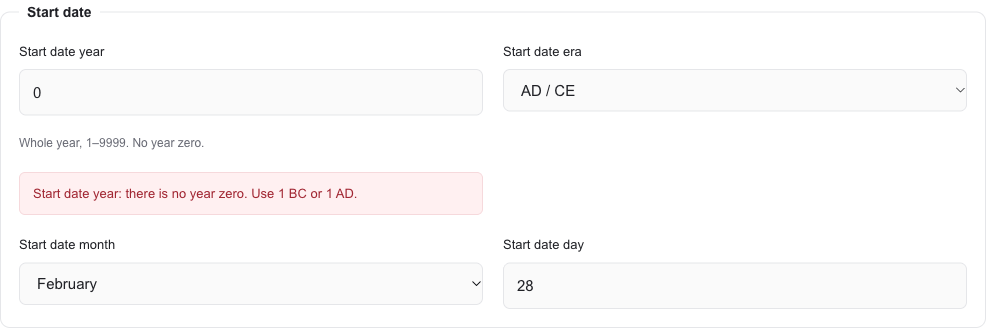
Historical dates need both an era and a calendar convention. This calculator extends the selected Gregorian or Julian rules across the whole interval. It does not switch calendars at a historical reform date. The civil labels move directly from 1 BCE to 1 CE; year zero is not accepted as a user-entered year.
- BCE-to-CE intervals without a civil year zero
- Explicit Gregorian or Julian calendar rules
- Day counts and calendar-unit breakdown
- Leap-year validation within the selected calendar
Cross the era boundary one day at a time
Start with December 31 in year 1 BCE and end with January 1 in year 1 CE. Enter a positive 1 in both year fields, select the two different eras, and use the same calendar. With Include end date off, the result is one day. Enabling that option counts the two named boundary dates and gives two days. This small example reveals an era or inclusivity mistake before it affects a much longer interval.
Civil BCE/CE labels move directly between those years. For arithmetic, ADEMN maps 1 BCE to astronomical year 0, 2 BCE to −1, and 1 CE to 1. That internal mapping lets a continuous day count cross the boundary. Entering a civil year 0 is rejected. Preserve the positive year and its era together when copying a result into a research note or spreadsheet.
Record a complete historical-date specification
A label such as ‘March 1, 1900’ needs a calendar before it identifies a day in this model. Choose Gregorian or Julian for the whole interval and record that choice alongside the result. In Gregorian mode, February 28 to March 1, 1900 spans one day. In Julian mode it spans two because February 29 exists under that calendar’s leap rule. A disagreement here can come from different conventions even when both arithmetic calculations are correct.
For a reproducible comparison, write down the starting era, year, month, and day, then the same four values for the end date. Add the selected calendar and whether the end date is included. Keep the source’s original wording in a separate field. Converting an uncertain or approximate historical description into an exact input would add certainty that this calculator cannot establish.
US Naval Observatory: calendarsUnderstand what happens around a calendar reform
The calculator applies one calendar continuously. October 4 to October 15, 1582 therefore spans eleven days when entered in Gregorian mode. A historical account that describes those dates as consecutive days is using a model with a change of calendar between the endpoints. Establish the location and source convention before interpreting that account, and record the two endpoint conventions alongside the source.
Both endpoints in this tool share the calendar selector. For a mixed-calendar source, establish a common representation first and document the conversion separately. A Julian calendar date describes calendar fields, while a Julian day number is a continuous count used by the arithmetic. Record the calendar labels and the counting convention explicitly when exchanging a result with another program or a research note.
Check invalid dates and reversed intervals
Try February 29, 1900 in Gregorian mode. The date fails validation. Change only the calendar to Julian and it becomes a valid input. A year outside the supported positive range of 1 through 9999, a fractional year, or a day beyond the selected month also produces an error. Correct the source or the chosen convention before recalculating. Validated calendar fields are required for the interval calculation.
Swap a valid start and end date to check direction. The signed total changes sign, while the calendar-unit breakdown describes the magnitude. With identical dates, elapsed days are zero and inclusive counting gives one. Read the day total and the years, months, and days breakdown as two descriptions with different units. Dividing days by 365 cannot reproduce calendar years across leap days and varying month lengths.
Worked examples you can try
Each example uses illustrative inputs. Load its named preset in the calculator above, then calculate to compare with the expected result.
From 1 BC to 1 AD
There is no entered year zero between these dates.
December 31, 1 BC → January 1, 1 AD
Proleptic Gregorian · Include end date: off
1 elapsed day
0 years, 0 months, 1 day
A Julian leap year
1900 is a leap year in the Julian calendar, but not in the Gregorian calendar.
February 28 → March 1, AD 1900
Julian · Include end date: off
2 elapsed days
The same named dates in the Gregorian calendar are 1 day apart.
Learn a little more
Calendar days, date differences, and month-end arithmeticMeasure BCE and CE intervals with an explicit calendarFrequently asked questions
Which calendar is the default?
The default is proleptic Gregorian: Gregorian rules extended through all supported years. You may explicitly choose Julian rules instead.
Does the calculator model a country's calendar reform?
No. Real adoption dates varied between places. Both dates use the single selected calendar, with no automatic gap or jurisdiction-specific reform.
Why is year zero rejected?
Civil BCE/CE numbering has no year zero. Internal arithmetic can use an astronomical year mapping, but dates shown to you always use positive years with BCE or CE labels.